
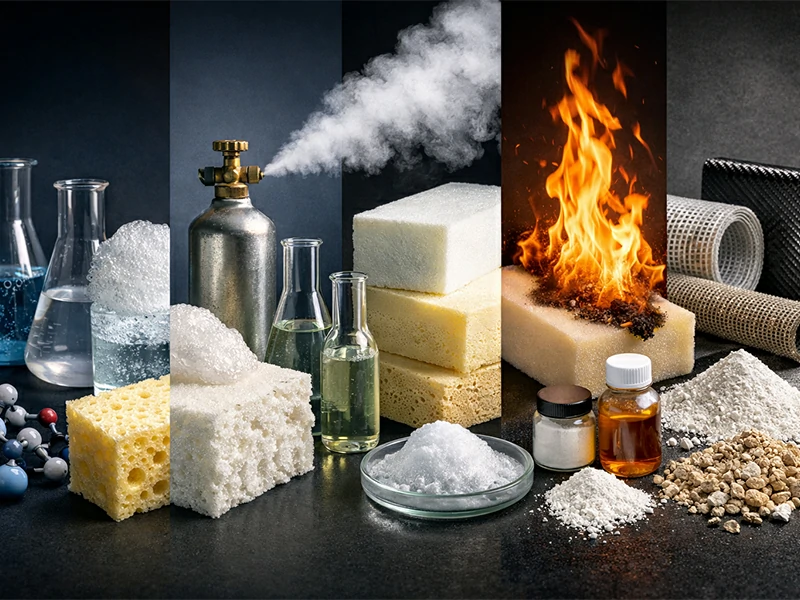
Polyurethane foam is not made from polyol and isocyanate alone. In real production, additives play a decisive role in how the foam reacts, expands, stabilizes, cures, and performs in the final application.
Additives transform the basic reaction into a controllable process across flexible, rigid, molded, and spray foam applications.
They influence foam cell structure, processing speed, density, dimensional stability, fire behavior, surface quality, comfort, and long-term durability.
Why additives matter in PU foam production
The reaction between polyol and isocyanate creates the polyurethane network and foam structure, but that reaction does not automatically deliver a good product.
Without additives, the process is difficult to control and the foam often lacks the properties required for industrial use.
Additives are used to guide both the chemistry and the physical behavior of the system.
They help regulate how fast the reaction proceeds, how the gas phase is generated, how cells open or close, how uniform the structure becomes, and how the finished foam performs in real conditions.
In practical production, additives help manufacturers achieve several goals:
- Maintain stable foaming behavior
- Improve cell uniformity
- Control hardness, resilience, or insulation performance
- Reduce shrinkage, cracking, or collapse
- Improve flame resistance or other special properties
- Match the formulation to machine conditions and mold design
- Balance quality with raw material cost
In short, additives are the tools that allow foam producers to fine-tune a formulation for a specific product and process.
Overview of the five main additive types
Although many substances may be added to a polyurethane system, most PU foam formulations rely on five major additive categories:
- Catalysts
- Surfactants
- Blowing agents
- Flame retardants
- Fillers and performance modifiers
Each category serves a different purpose. Some directly affect reaction kinetics.
Others shape the cell structure or improve final properties. In many formulations, the final result depends less on one additive alone and more on how all of them work together.
Overview of 5 additive types in PU foam production
| Additive Type | Main Function | Key Impact on Foam | Typical Use Focus |
| Catalysts | Control reaction speed | Cream time, gel time, cure, productivity | Almost all PU foams |
| Surfactants | Stabilize foam cells and control structure | Cell size, open/closed cells, surface quality | Flexible, rigid, molded, spray foams |
| Blowing Agents | Create foam expansion | Density, insulation, cell structure | Flexible and rigid foams |
| Flame Retardants | Improve fire performance | Flammability, smoke behavior, compliance | Rigid insulation, transport, construction |
| Fillers / Performance Modifiers | Adjust cost and properties | Strength, density, hardness, thermal behavior | Specialized or cost-sensitive formulations |
Catalysts
Catalysts are among the most important additives in polyurethane foam production. Their job is to accelerate specific chemical reactions so the foam develops in a controlled and repeatable way.
In polyurethane foaming, two major reactions happen at the same time:
- The gelling reaction, mainly between polyol and isocyanate, which builds the polymer network
- The blowing reaction, often involving isocyanate and water, which generates gas and causes expansion
Catalysts help control the balance between these two reactions. That balance is critical.
If blowing occurs too quickly and the polymer matrix is still too weak, the foam may collapse. If gelling happens too fast, the foam may not rise properly or may show poor flow and incomplete mold filling.
Main catalyst categories
PU foam catalysts are commonly divided into two broad groups:
Amine catalysts
These are widely used to promote the blowing reaction and sometimes the gelling reaction as well. They are especially important in water-blown systems because they help drive carbon dioxide generation.
Amine catalysts are often selected when manufacturers need to adjust:
- Rise profile
- Airflow or open-cell behavior
- Surface cure
- Demold time
- Overall reaction balance
Metal catalysts
These are often used to promote gelling and polymer formation. Tin-based catalysts have historically been common in many polyurethane systems, although catalyst choice today may also reflect environmental and regulatory considerations.
Metal catalysts are often used when producers want:
- Stronger polymer development
- Faster cure
- Better dimensional stability
- Improved final mechanical properties
Why catalyst balance matters
A catalyst package is rarely chosen based on one number alone. What matters is how the catalyst combination fits the full formulation and process conditions.
For example:
- In flexible slabstock foam, manufacturers often need good rise control and uniform open-cell structure
- In molded seat foam, cure speed and demold efficiency become more important
- In rigid insulation foam, dimensional stability and closed-cell integrity are critical
- In spray foam, reaction speed must match on-site application conditions and substrate behavior
Even a slight shift in catalyst dosage can affect:
- Cream time
- Rise time
- Gel time
- Tack-free time
- Cell opening
- Surface skin formation
- Compression set
- Productivity on the line
Common catalyst-related problems
When catalysts are poorly matched, the following issues may appear:
- Foam collapse
- Shrinkage
- Surface cracking
- Internal voids
- Poor mold filling
- Scorching or overheating
- Inconsistent density distribution
- Slow demolding or incomplete cure
This is why catalyst selection is never isolated from machine pressure, raw material temperature, ambient humidity, mold temperature, mixing quality, and product geometry.
Practical selection points for catalysts
When selecting catalysts, producers usually consider:
- Foam type: flexible, rigid, molded, spray, integral skin
- Processing method: high-pressure or low-pressure mixing
- Water level or blowing system
- Required production speed
- Product thickness and geometry
- Desired open-cell or closed-cell structure
- Emission and odor expectations
A good catalyst system should provide a stable reaction window rather than the fastest reaction possible. In many cases, overly aggressive catalysis creates more defects, not fewer.
Surfactants
Surfactants are the additives that help control foam cell formation and stability. In PU foam production, silicone-based surfactants are especially common because they provide strong control over the gas-liquid interface during foaming.
As the reaction mixture expands, countless cells form and grow. Without surfactants, these cells may merge too easily, rupture too early, or become irregular. The result can be coarse foam, collapse, poor surface finish, or unstable density distribution.
Surfactants help the foam structure develop in a more uniform way.
Main functions of surfactants
Surfactants typically serve several roles at once:
- Stabilize the cell structure during rise
- Control cell size and uniformity
- Promote open-cell or closed-cell behavior
- Improve flow and mold filling
- Reduce the risk of collapse
- Improve surface appearance
The specific surfactant type influences whether a foam becomes soft and breathable, rigid and insulating, or smooth-skinned for molded parts.
Open-cell vs closed-cell influence
One of the most important roles of surfactants is controlling whether cells remain open or closed.
In flexible foam
Manufacturers often want a more open-cell structure. This improves:
- Breathability
- Softness
- Compression recovery
- Comfort performance
In rigid insulation foam
Manufacturers usually want high closed-cell content. This improves:
- Thermal insulation
- Dimensional stability
- Moisture resistance
- Compressive strength
A surfactant that works well in flexible slabstock foam may not suit rigid refrigerator insulation foam at all. The formulation target is different, so the surfactant package must also be different.
Surfactants and processing stability
Surfactants also affect how forgiving the formulation is during production. A properly selected surfactant can help reduce sensitivity to small process fluctuations.
For example, it may help when:
- Mixing efficiency varies slightly
- Ambient temperature changes
- Mold geometry is complex
- Foam rise must remain uniform across a wide panel or block
In industrial production, this contributes to lower reject rates and more consistent product quality.
Signs of poor surfactant selection
Common problems linked to surfactant mismatch include:
- Coarse or uneven cells
- Collapse after rise
- Shrinkage in rigid foam
- Pinholes or surface defects
- Poor foam flow in the mold
- Inconsistent hardness across the part
- Reduced insulation performance
Because surfactants strongly affect foam morphology, they are often adjusted together with catalysts and blowing agents during formulation optimization.
Practical selection points for surfactants
Important considerations include:
- Flexible vs rigid foam target
- Desired cell openness
- Density range
- Blowing system type
- Machine mixing conditions
- Mold shape or panel thickness
- Required surface finish
In other words, surfactants are not just “stabilizers.” They are structural control tools that shape how the foam actually forms.
Blowing agents
Blowing agents are the additives or components responsible for foam expansion. They create the cellular structure that makes polyurethane foam light, insulating, and cushioning.
Without a blowing mechanism, polyurethane would form a solid polymer rather than foam.
How blowing works
In PU systems, foaming can happen through two main approaches:
Chemical blowing
Water is a common chemical blowing component. It reacts with isocyanates to produce carbon dioxide gas. That gas expands the reacting mixture and forms cells.
This method is widely used in many flexible and some rigid foam systems.
Physical blowing
A physical blowing agent vaporizes due to reaction heat or processing conditions and creates expansion. These systems are often used where lower thermal conductivity or specific density and cell characteristics are needed.
Different blowing agents can influence:
- Foam density
- Cell size
- Closed-cell content
- Insulation value
- Dimensional stability
- Processing safety and environmental profile
Why blowing agent choice is critical
Blowing agents do much more than reduce density. They strongly shape product performance.
For example:
- In flexible furniture foam, the aim may be softness, resilience, and stable rise
- In rigid refrigerator insulation, the aim may be fine closed cells and low thermal conductivity
- In spray foam, the blowing system must support field processing, adhesion, and dimensional control
- In molded foam, expansion must be predictable and compatible with mold filling
The wrong blowing system can create problems such as:
- Foam shrinkage
- Collapse
- Poor insulation
- Irregular density
- Weak cell walls
- Poor adhesion
- Excessive friability in rigid foam
Water as a blowing component
Water remains one of the most widely used blowing components in polyurethane production. It is practical and effective, but its use must be balanced carefully because it affects both gas generation and polymer network chemistry.
When water level rises:
- Density often decreases
- Urea content increases
- Hardness and brittleness may change
- Reaction profile changes
- Cell opening behavior may change
This is why water level cannot be adjusted casually without rebalancing catalysts, surfactants, and sometimes isocyanate index.
Physical blowing systems
Physical blowing agents are often selected for rigid foam applications that require strong insulation performance. The specific choice depends on performance targets, processing requirements, regulations, and environmental considerations.
Manufacturers evaluate factors such as:
- Thermal conductivity target
- Closed-cell retention
- Equipment compatibility
- Storage and handling safety
- Regulatory compliance
- Cost and long-term availability
General comparison of blowing approaches in PU foam
| Blowing Approach | Typical Principle | Main Advantages | Main Challenges | Common Use Areas |
| Chemical blowing | Gas generated by reaction, often using water | Simple, widely used, cost-effective | Can affect reaction balance and foam properties strongly | Flexible foam, some rigid foam |
| Physical blowing | Volatile agent expands during foaming | Can support lower thermal conductivity and tailored cell structure | Handling, compliance, formulation complexity | Rigid insulation, spray foam, specialty systems |
Blowing agents and environmental direction
Blowing systems are increasingly evaluated not only for performance, but also for sustainability, emissions, and regulatory acceptance.
This has pushed the industry toward more environmentally responsible solutions while still trying to preserve foam quality and production stability.
For producers, the challenge is no longer simply “which blowing agent works,” but rather “which blowing system delivers the best combination of performance, compliance, cost, and long-term supply security.”
Flame retardants
Flame retardants are additives used to improve the fire behavior of polyurethane foam. This category is especially important in applications where safety standards or regulations apply, such as construction, insulation, appliances, automotive interiors, and some furniture products.
Polyurethane foam is a versatile material, but like many organic polymers, it may require fire-performance improvement depending on the end use.
Flame retardants help reduce flammability or slow flame spread, though they do not automatically make foam “fireproof.”
Why flame retardants are used
The need for flame retardants depends on the final application and applicable standards. For example:
- Building insulation often requires fire-performance considerations
- Appliance insulation may require controlled behavior under heat exposure
- Automotive components may need to meet interior fire standards
- Public seating or transport-related products may need stricter compliance
The specific requirement differs by market and product category.
How flame retardants work
Flame retardants can act through different mechanisms, such as:
- Promoting char formation
- Interfering with combustion reactions
- Reducing heat release
- Diluting combustible gases
- Improving resistance to flame propagation
Some function mainly in the condensed phase, while others act in the gas phase. The practical outcome is improved fire performance under defined test conditions.
Flame retardants and formulation trade-offs
Adding flame retardants is rarely a one-direction improvement. They may also affect:
- Foam density
- Friability
- Mechanical properties
- Processing viscosity
- Cell structure
- Cost
- Odor or emissions profile
This means a flame-retardant formulation must be balanced carefully. A system that performs better in a flame test may process worse on the line if the additive load is too high or poorly integrated.
Typical selection considerations
When choosing a flame-retardant strategy, manufacturers often evaluate:
- Required fire standard
- Foam type and density
- Effect on mechanical properties
- Compatibility with polyol blend
- Influence on processing and storage stability
- Regulatory acceptance in the target market
Common challenges
Poorly optimized flame-retardant systems may lead to:
- Increased viscosity
- Poor mixing
- Cell irregularity
- Brittleness
- Reduced compression strength or rebound
- Higher cost without stable performance
Because of this, flame retardants are usually selected as part of the whole formulation design rather than added at the end as a simple fix.
Application perspective
In rigid foam, flame retardants are often part of the performance package for insulation and appliance applications. In flexible foam, their role depends more strongly on product category and standard requirements.
The key point is that fire performance must be evaluated together with processing practicality and the final use environment.
Fillers and performance modifiers
The fifth additive category includes fillers and other performance modifiers used to adjust cost, appearance, processing, or physical properties.
This is a broad category because different producers use different modifiers depending on the foam system and product goal.
Some are added mainly to reduce formulation cost. Others are used to improve stiffness, thermal behavior, acoustic performance, dimensional stability, or special functional properties.
What fillers do
Fillers are solid materials introduced into the formulation to modify foam behavior or economics. Depending on the type and loading level, fillers may influence:
- Density
- Hardness
- Compression strength
- Surface feel
- Dimensional stability
- Thermal resistance
- Cost per unit volume
- Processing viscosity
In some systems, fillers help create a more economical product. In others, they are used to engineer a specific performance profile.
What performance modifiers do
Performance modifiers may include materials used to improve:
- Color stability
- Anti-oxidation behavior
- UV resistance
- Hydrolysis resistance
- Anti-static behavior
- Acoustic damping
- Mechanical reinforcement
These are especially relevant in specialty foams or products designed for demanding service conditions.
The benefits and risks of fillers
Fillers can be valuable, but they must be used carefully. Excessive or poorly dispersed filler may create problems such as:
- Higher viscosity and poor flow
- Uneven cell structure
- Reduced resilience
- Surface defects
- Lower foam uniformity
- Increased wear on equipment
This is why filler loading must be matched with the mixing system, material temperature, surfactant choice, and final product requirements.
Examples of where modifiers are important
- Rigid insulation foammay require modifiers that improve dimensional stability
- Automotive foammay need enhanced durability or reduced fogging tendency
- Construction spray foammay need better adhesion or weather resistance
- Furniture foammay need better comfort balance, lower odor, or longer life
In many cases, these additives are what transform a general-purpose foam into a market-specific product.
How the five additive types work together
It is useful to study each additive type separately, but in real production they never act alone. A polyurethane foam system behaves as an interconnected formulation.
For example:
- The blowing agentaffects expansion and cell formation
- The surfactantstabilizes those cells
- The catalystcontrols when expansion and polymer build-up happen
- The flame retardantmay change viscosity and influence cell structure
- The filler or modifiermay further affect flow, hardness, or processing stability
That is why formulation work is often about balance rather than maximum dosage.
How additives influence key foam properties
| Property / Process Target | Main Additives Involved | Notes |
| Reaction speed | Catalysts | Strong effect on cream, gel, tack-free time |
| Cell structure | Surfactants, blowing agents | Determines uniformity, openness, and stability |
| Density control | Blowing agents, fillers | Also affected by processing and formulation balance |
| Thermal insulation | Blowing agents, surfactants, flame retardants | Especially important in rigid closed-cell foams |
| Fire performance | Flame retardants | Must be balanced with mechanical and processing needs |
| Mechanical performance | Catalysts, fillers, modifiers | Also depends on base polyol and isocyanate system |
| Process stability | All five categories | Real-world line stability depends on interaction among them |
Additive selection by foam application
Different foam applications require different additive priorities. The five additive categories remain the same, but the formulation emphasis changes.
Flexible foam for furniture and bedding
In flexible foam, producers often prioritize:
- Comfort
- Resilience
- Open-cell structure
- Low compression set
- Stable rise
Here, catalysts and surfactants are especially critical, while blowing balance strongly affects density and feel.
Memory foam and slow rebound foam
These systems require careful control of:
- Reaction speed
- Cell openness
- Viscoelastic behavior
- Surface cure and internal cure balance
Additives must be selected for comfort performance, not only for process speed.
Molded automotive seating foam
- Important targets often include:
- Mold filling
- Fast demold
- Dimensional consistency
- Mechanical durability
- Low defect rate
Catalyst package and surfactant selection are especially important here.
Rigid insulation foam
Key priorities include:
- Closed-cell content
- Thermal conductivity
- Dimensional stability
- Compression strength
- Flame performance where required
Blowing agents, surfactants, and flame retardants often take center stage.
Spray foam
Spray systems require a practical balance between:
- On-site reactivity
- Adhesion
- Expansion control
- Substrate behavior
- Ambient temperature tolerance
The additive package must support field application, not just laboratory performance.
Common formulation mistakes related to additives
Many PU foam production problems can be traced back to additive imbalance rather than major raw material failure.
Common mistakes include:
Using catalysts to solve every problem
A formulation that rises poorly is not always fixed by adding more catalyst. The root cause may involve surfactant mismatch, water imbalance, poor mixing, low raw material temperature, or mold design limitations.
Changing water level without rebalancing the system
Water affects much more than density. It changes reaction chemistry, cell structure, hardness, and cure behavior. A water adjustment should be treated as a full formulation change.
Choosing surfactant only by previous habit
A surfactant used in one foam type may not perform well in another density range or process setup. Application-specific validation matters.
Adding flame retardant without checking process impact
Flame retardants can change viscosity and foam morphology. Fire performance must be balanced with manufacturability.
Overloading fillers to reduce cost
Lower cost per kilogram does not always mean lower total cost. Excess filler can increase defects, reduce quality, and raise rejection or complaint risk.
How manufacturers optimize additive packages
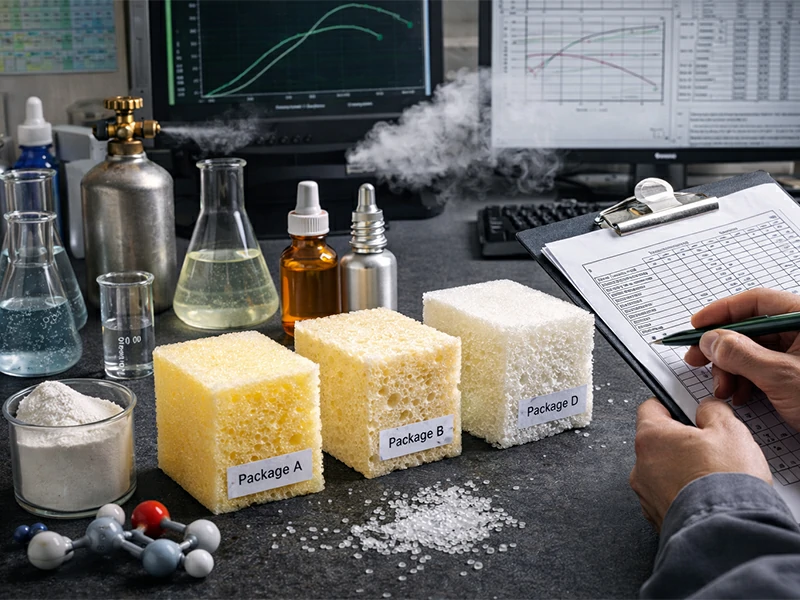
Professional foam producers usually optimize additives through controlled trial work rather than random adjustment.
A typical optimization approach includes:
- Define the performance target clearly
- Identify the most critical process variables
- Adjust one key additive area at a time
- Observe reaction profile and physical properties together
- Confirm performance in real production conditions
Laboratory results are important, but line performance is the final test. A formulation that looks good in a small cup test may behave differently in slabstock, molded production, spray application, or continuous panel manufacturing.
That is why additive optimization usually requires both formulation knowledge and process understanding.
Quality control points when working with additives
To keep additive performance stable, manufacturers should also control handling and storage.
Important points include:
- Keep additive dosing accurate
- Maintain storage conditions within recommended limits
- Prevent contamination with water or foreign material
- Monitor viscosity and appearance when relevant
- Use consistent metering equipment
- Record formulation changes and batch behavior
Even the best additive package can fail if dosing is inconsistent or raw material temperature drifts too much.
In industrial production, repeatability matters as much as chemistry.
Future trends in PU foam additives
The additive landscape in polyurethane foam production continues to evolve. Manufacturers are increasingly looking for additives that support both performance and sustainability.
Current development directions often include:
- Lower-emission catalyst systems
- More environmentally responsible blowing solutions
- Improved flame-retardant efficiency
- Better compatibility with automated production
- Additives designed for higher productivity and tighter quality control
- Performance modifiers for lightweight and energy-efficient applications
The trend is moving toward smarter additive systems that provide multiple benefits at once, such as better process stability, reduced emissions, and improved product performance.
For foam manufacturers, this means additive selection is becoming more strategic. It is no longer just a technical detail handled in the background. It is part of how companies improve quality, meet regulations, and stay competitive.
Additives are essential to polyurethane foam production because they transform a basic reactive system into a controllable, application-specific material.
The five main types of additives are:
- Catalysts, which control reaction speed and cure behavior
- Surfactants, which stabilize cells and shape foam structure
- Blowing agents, which create expansion and influence density and insulation
- Flame retardants, which improve fire performance where required
- Fillers and performance modifiers, which adjust cost and specialized properties
Each type plays a distinct role, but the real value comes from how they work together.
A successful PU foam formulation is not built by maximizing one additive. It is built by balancing additives to match the raw materials, machine conditions, application requirements, and production goals.
For manufacturers, understanding additives leads to better decisions in formulation design, troubleshooting, quality control, and product development.
It helps reduce defects, improve consistency, and produce foam that performs the way the market expects.
Sourcing Blended Polyol Systems?
SPC formulates rigid, flexible, spray and elastomer polyol systems for refrigerators, cold-storage panels, SIP plants and automotive seats. ISO 9001 plant in Jiangyin, China · 60+ countries served.


