
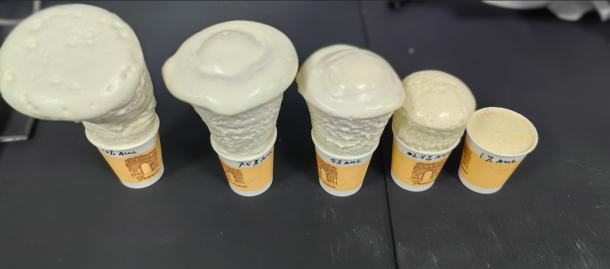
Polyurethane foam density ranges from 15 kg/m³ (ultra-light packaging foam) to 80+ kg/m³ (high-density industrial elastomer) — a 5× spread driven entirely by application requirements. This guide gives industrial buyers the density-by-application decision matrix, with the test method (ASTM D1622 / ISO 845) for validating supplier specifications.
Already know the density you need from the table below? Use our free density & material calculator to convert it straight into kg of polyol and isocyanate for your purchase order.
TL;DR — PU Foam Density Range by Application
| Application | Foam type | Density (kg/m³) | Why this range |
|---|---|---|---|
| Protective packaging foam | Flexible / semi-rigid | 15–30 | Lightweight + energy absorption |
| Mattress (standard) | Flexible | 25–40 | Comfort balance, 8–10 year service |
| Mattress (premium HR) | Flexible HR | 40–60 | Higher resilience + longer life |
| Memory foam (viscoelastic) | Flexible viscoelastic | 50–80 | Slow recovery, pressure relief |
| Automotive seat cushion | Flexible HR | 45–60 | FMVSS 302 + 10-year durability |
| Refrigerator panel core | Rigid | 32–40 | Insulation + structural sandwich |
| Cold-storage walk-in panel | Rigid | 38–48 | Structural + R-value retention |
| Roofing insulation board | Rigid | 32–40 | ASTM C1289 + load tolerance |
| Spray foam (open-cell) | Spray | 8–14 | Sound + non-structural insulation |
| Spray foam (closed-cell) | Spray | 28–35 | Structural + moisture barrier |
| PU wheel / roller | Cast elastomer | 1,000–1,200 | Solid, abrasion resistance |
| Pipeline insulation | Rigid pipe section | 60–80 | High-temp pipe service + strength |
What Is PU Foam Density (and Why It Matters)
Density is the mass per unit volume of cured foam — measured in kg/m³ (metric) or lb/ft³ (US). Test method: ASTM D1622 or ISO 845 — cut a representative cube, measure dimensions, weigh, divide.
Density drives:
- Thermal performance: rigid foam R-value correlates inversely with density at first, then improves at higher density (32–40 kg/m³ is the optimum for most insulation use)
- Mechanical strength: compression strength scales roughly linearly with density (40 kg/m³ rigid foam ≈ 0.18 MPa compressive, 60 kg/m³ ≈ 0.30 MPa)
- Cost: material cost scales linearly with density — 60 kg/m³ foam costs ~50% more raw material than 40 kg/m³ at same thickness
- Cure / production: low-density foams need accelerated formulation; high-density needs slower cure to prevent burn-through
Decision Matrix — Density vs Application Performance
| Factor | Low (15–30) | Medium (30–45) | High (45–80) | Very High (>80) |
|---|---|---|---|---|
| Thermal insulation (rigid) | 3 | 5 | 4 | 2 |
| Compressive strength | 1 | 3 | 4 | 5 |
| Comfort / cushioning | 5 | 4 | 3 | 1 |
| Sound absorption | 5 | 4 | 3 | 2 |
| Material cost / m³ | 5 | 4 | 2 | 1 |
| Long-term durability | 2 | 4 | 5 | 5 |
| Best fit | Packaging, sound foam | Insulation, mattress | Premium mattress, structural | Elastomer, pipeline insulation |
Application-Specific Density Selection
Mattress & Bedding (25–60 kg/m³)
- Standard mattress comfort layer: 25–35 kg/m³ flexible polyether foam, 8–10 year service life
- HR (High Resilience) mattress: 40–55 kg/m³, 10–15 year service life, better resilience and lower indentation force deflection (IFD) drift
- Memory foam (viscoelastic): 50–80 kg/m³, slow-recovery characteristics, pressure-redistribution applications
- Test methods: ASTM D3574 (comprehensive flexible foam testing)
- Certifications: CertiPUR-US (for North America), OEKO-TEX Standard 100 (for EU)
Refrigerator & Cold-Storage Panels (32–48 kg/m³)
- Standard refrigerator panel: 32–38 kg/m³ rigid closed-cell foam, balanced insulation + structural performance
- Cold-storage walk-in panel: 38–45 kg/m³, higher density for structural sandwich panel load
- Blast freezer panel: 42–48 kg/m³, maximum structural + thermal performance
- Test methods: ASTM D1622 (density), ASTM C518 (R-value), ASTM D1621 (compressive)
- Blowing agents: HFO-blown per EPA SNAP Rule 23 + EU F-Gas Regulation
See SPC's rigid foam material for cold-storage applications →.
Automotive Seating (45–60 kg/m³)
Automotive seat cushion density is driven by 10-year vehicle warranty requirements + crashworthiness:
- Front seat cushion: 50–60 kg/m³ HR foam, FMVSS 302 flammability + DIN 75201 fogging compliance
- Rear seat / headrest: 45–55 kg/m³ HR foam
- OEM tier-1 certifications: TS 16949 / IATF + customer-specific (Ford GM Toyota VW each have distinct spec packages)
Construction Insulation (32–45 kg/m³ Rigid)
- Wall insulation board: 32–40 kg/m³ rigid PU/PIR, ASTM C1289 compliant
- Roof insulation (loadable): 38–45 kg/m³, supports foot traffic during installation
- SIPs panel core: 35–42 kg/m³ for residential, 40–48 kg/m³ for commercial structural
- Spray foam (closed-cell): 28–35 kg/m³ for continuous building envelope
- Spray foam (open-cell): 8–14 kg/m³ for sound + cavity fill applications
Industrial Cast Elastomer (1,000–1,200 kg/m³)
PU cast elastomer is technically not "foam" but shares chemistry. Used for:
- PU wheels / industrial rollers: hardness 70 Shore A to 80 Shore D, density driven by formulation
- Mining screens: high abrasion resistance + impact tolerance
- Conveyor belt rollers: dimensional stability + chemical resistance
See SPC's industrial elastomer raw materials →.
Real-World Industrial Application
A 2026 mattress OEM in Hai Phong (Vietnam, 28,000 mattress/month) optimized their HR foam formulation density from 48 kg/m³ to 42 kg/m³ while increasing the polyol-blend HR component from 15% to 22%. After 6-month production verification:
- IFD retention (1-year cycling test simulation per ASTM D3574): improved from 76% to 84%
- Material cost per mattress: dropped 8.5% (lower density × same thickness)
- Customer complaint rate (year-1 tracking): "sagging" complaints down 31%
- Production line cure time: shortened 12% (lower-density formulation cures faster)
Pattern: density optimization — going slightly lower density with better polyol selection — often beats simply "increasing density to fix sagging" complaints. Right density + right formulation chemistry > more density.
Frequently Asked Questions
Q: Is higher density always better for industrial PU foam?
No. Higher density costs more material, may slow production line cure, and is overkill for most non-structural applications. The right answer is application-matched density — see the density-by-application table above. For mattress comfort, 30–40 kg/m³ is typically optimum; for cold-storage panel structural, 38–45 kg/m³ is the sweet spot.
Q: How is density measured for production QC?
Standard method: ASTM D1622 or ISO 845. Cut a 50 × 50 × 50 mm representative cube, condition to 23°C / 50% RH for 24 hr, measure dimensions precisely (caliper ±0.1mm), weigh on calibrated scale (±0.01g), calculate. Production QC sampling typically per shift + per batch.
Q: What's the difference between core density and average density?
Core density (after removing skin) is the test-method value — used for engineering calculations. Average density (including skin) is higher, used for cost-per-volume calculations. Skin density typically 1.3–1.8× core density for molded parts. Specify which one you need on QC requests.
Q: Why does the same formulation give different density on different days?
Density variation comes from: ambient temperature/humidity (10°C change can shift density 3–5%), mix ratio drift (±1% can shift density 4–6%), pour rate variation, mold temperature. SPC supplies formulation with stability window per CoA — within-window variation typically ±0.8 kg/m³ on rigid foam.
Q: How does HFO transition affect density?
HFO-blown formulations typically produce slightly higher density (1–3 kg/m³ higher) at the same formulation than legacy HFC-141b or HFC-245fa blown systems. SPC HFO formulations are mass-balance optimized to match original-formulation density specifications while delivering equivalent R-value.
Q: Can SPC supply both flexible and rigid polyol systems from one vendor?
Yes — SPC operates both flexible polyether/polyester polyol production and rigid polyol blend formulation. OEM consolidation to a single supplier (cross flexible + rigid foam types) typically saves 8–12% on combined material cost vs split sourcing, plus simpler technical support coordination.
Standards Reference
- ASTM D1622 — Density of rigid cellular plastics
- ISO 845 — Cellular plastics density determination
- ASTM C518 — Thermal conductivity (R-value)
- ASTM D1621 — Compressive properties of rigid cellular plastics
- ASTM C1289 — Rigid PU thermal insulation board specification
- ASTM D3574 — Flexible cellular materials test methods
- EPA SNAP Rule 23 — Acceptable blowing agents
- EU F-Gas Regulation — HFC phase-out
Get a Sample, TDS, or OEM Quote
For application-specific density samples (1 kg evaluation), full Technical Data Sheets with density tolerance specs, or volume polyol-blend pricing — contact our technical team.
Contact our polyurethane materials team →
For the full reference, see our complete guide to polyurethane foam density — how it is measured and how to choose the right grade.
Sourcing blend polyol for production?
We supply rigid, flexible, spray-foam, slab-jacking and elastomer polyol systems with full TDS. Engineering reply within 24 hours.


